Direct Mail Campaign Timeline: How Long Does a Campaign Really Take?
A realistic phase-by-phase timeline for direct mail — design, list prep, printing, and USPS transit — plus a sample 6-week schedule you can copy for your next campaign or event.
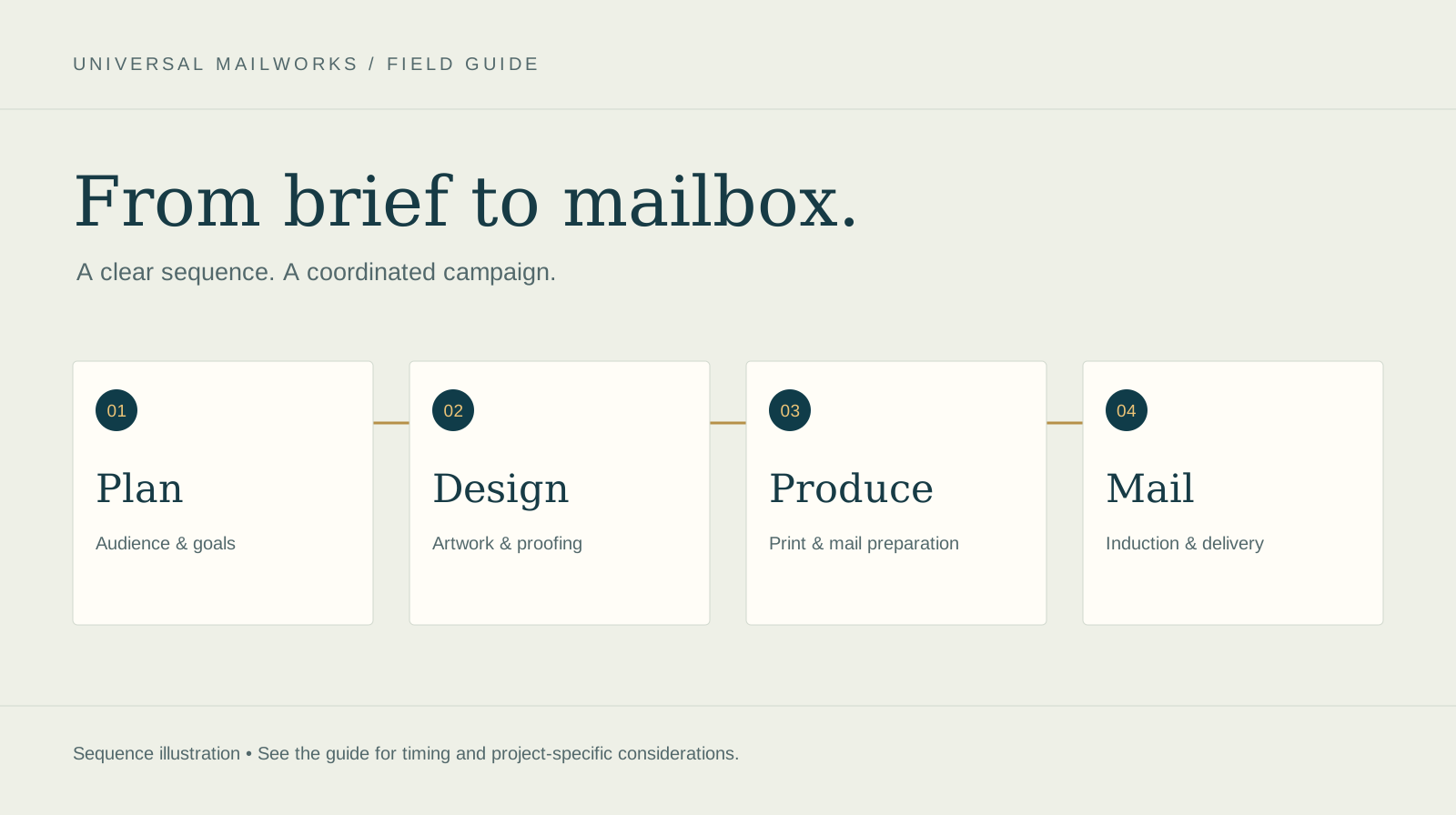
The four phases of every direct mail campaign
Every mailing — a 500-piece EDDM drop or a 250,000-piece political program — moves through the same four phases. The size changes; the sequence doesn't. Miss the handoff between any two phases and the drop date slips.
- Strategy & data — Define the offer, audience, mail class, and quantity. Order or clean the list. Typical duration: 3–7 days.
- Design & proofing — Creative, copy, USPS layout compliance (address block, IMB clear zone, aspect ratio). Typical duration: 5–10 days including 1–2 rounds of revisions.
- Print & mail-house — Prepress, printing, cutting, addressing, tray-up, USPS paperwork (3602/3600). Typical duration: 3–5 business days after final approval.
- USPS transit — Induction at the SCF, sorting, and delivery. 1–5 days for First-Class, 3–10 days for Marketing Mail letters, 5–14 days for flats and EDDM.
A sample 6-week direct mail timeline
This is the timeline we use for a typical 5,000–25,000-piece Marketing Mail campaign with net-new creative. Anchor everything to the in-home date — the date you want the piece to land — and count backwards.
| Week | Phase | What happens | Who owns it |
|---|---|---|---|
| Week 6 (T-42 days) | Strategy | Define offer, audience, quantity, mail class, and in-home date. Kick off list order. | Client + strategist |
| Week 5 (T-35 days) | Data | Receive and clean list (NCOA, dedupe, CASS). Confirm final count and postage math. | Mail-house / data team |
| Week 4 (T-28 days) | Design | First creative round. Copy, imagery, USPS layout, IMB and address block placement. | Designer + client |
| Week 3 (T-21 days) | Proofing | 1–2 revision rounds. Sign off on final print-ready PDF and address list. | Client |
| Week 2 (T-14 days) | Print & addressing | Prepress, plate, print, cut, address, tray, and manifest. USPS paperwork prepared. | Print & mail-house |
| Week 1 (T-7 days) | USPS induction | Trays inducted at SCF. Marketing Mail letters typically in-home 3–10 days later. | Mail-house + USPS |
How the mail class changes the timeline
| Mail class | Best for | USPS transit | Total lead time |
|---|---|---|---|
| First-Class Mail | Time-sensitive, higher-value offers | 1–5 days | 2–3 weeks with ready art |
| Marketing Mail letters | Prospecting, promotions, nonprofit appeals | 3–10 days | 4–6 weeks |
| Marketing Mail flats | Catalogs, larger postcards, GOTV pieces | 5–14 days | 5–7 weeks |
| EDDM Retail | Local saturation by carrier route | 5–10 days after drop-off | 3–4 weeks |
| Nonprofit Marketing Mail | 501(c)(3) fundraising appeals | 5–14 days | 5–7 weeks (auth check adds time) |
Planning around an event or deadline
The single most common planning mistake is anchoring the timeline to the print date instead of the in-home date. Work backward from when the piece needs to arrive:
- Local event (open house, grand opening): in-home 5–7 days before. Use EDDM or First-Class.
- Sale window or promotion: in-home 3–5 days before the promotion starts, with a redemption window of 2–4 weeks.
- Political GOTV: plan a 3-piece cadence starting 21 days out (persuasion), 10 days out (contrast), and 3–5 days out (turnout). See the 2026 midterm GOTV timeline.
- Nonprofit year-end appeal: mail by Dec 5 for holiday-week delivery. Backdate to a mid-October kickoff for creative and list work.
Rush campaigns: what can (and can't) compress
When the deadline is tight, three levers save days:
- Bring print-ready art. Skipping design and proofing saves 5–10 days on its own.
- Upgrade to First-Class postage. Cuts USPS transit from 5–14 days to 1–5. Adds ~$0.20/piece.
- Use a pre-cleaned list. A recently NCOA'd list skips 2–3 days of data prep.
With all three, a small campaign can drop in 5–7 business days. What can't be compressed: USPS transit windows for Marketing Mail, nonprofit authorization checks, and the physical time to print and address 25,000+ pieces.
Where timelines usually slip
- Late list delivery. The single biggest cause of missed drop dates. Order lists in Week 1, not Week 4.
- Revision round three. Every extra revision cycle costs ~2 days. Lock creative after round two.
- Address block problems. A layout that fails USPS clear-zone rules gets bounced at intake. Ask for a USPS-compliant template before design starts.
- Underestimating Marketing Mail transit. Plan the long end of the 3–10 day window, especially around federal holidays.
Ready to plan your next drop?
Send us your in-home date and quantity — we'll build a working backward-schedule with realistic proof, print, and induction dates. Pair this guide with our Direct Mail Pricing Guide to size the budget alongside the calendar.
Frequently asked questions
Why Universal Mailworks
- Family-owned, 15+ years in business (60+ years combined team experience)
- 220M+ pieces printed and mailed, 99.9% on-time delivery
- 10,000 jobs produced per year for 1000+ clients
- One accountable team for design, printing, postage and USPS drop-off
- Union printing available
Service Areas
We serve businesses across Southern California, including Los Angeles County, Orange County, Riverside County, San Bernardino County, San Diego County, Ventura County, Imperial County, Kern County, and Monterey County.
Contact
Universal Mailworks6910 Aragon Circle, Suite B
Buena Park, CA 90620
Phone: (562) 261-9100